Commercial Chain Link Gates in Clovis, Portales, and Friona: Types, Pros, Cons, and What Actually Works
Commercial chain link gates aren’t all the same, and picking the wrong style is how you end up with a gate that drags, won’t latch, gets jammed with gravel, or turns into a постоян “gate won’t close” problem. Out here around Clovis, Portales, and Friona, the biggest gate killers are wind, blowing sand, gravel, uneven ground, and heavy daily traffic.
Below is a practical breakdown of the most common commercial chain link gates, with clear pros and cons, and a quick guide to choose the right one the first time.
Fast gate picker (no guessing)
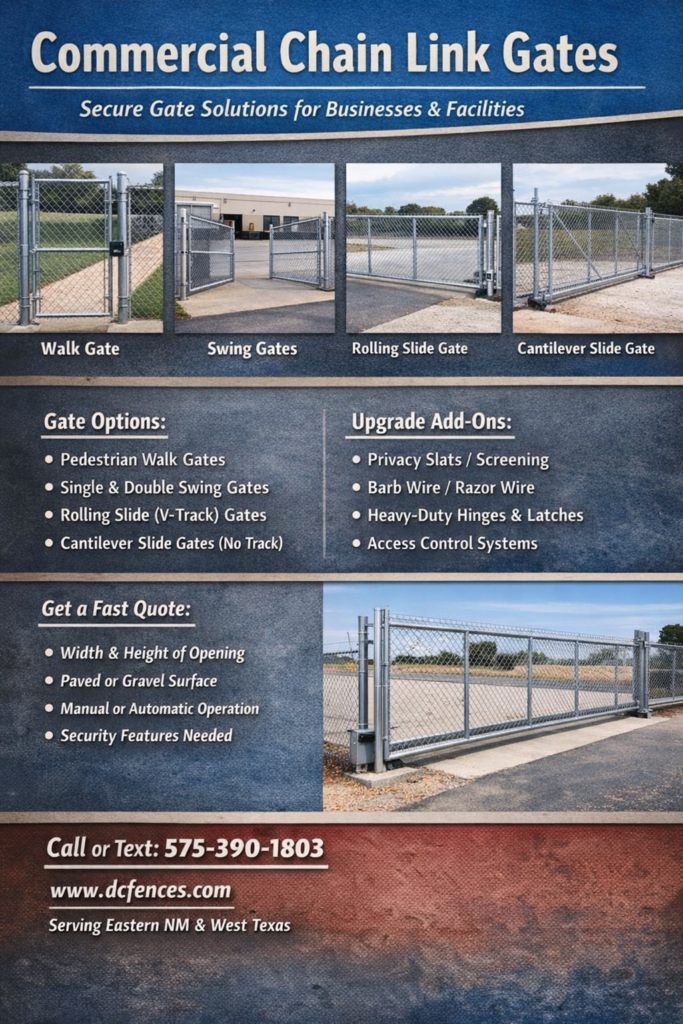
- Walk traffic only: pedestrian walk gate
- Small driveway + plenty of swing room: single swing gate
- Wider driveway + swing room: double swing gate
- Paved entrance that stays clean: rolling slide gate (v-track)
- Gravel, dust, snow, uneven ground, or you want fewer headaches: cantilever slide gate
- No room to swing and no room to slide sideways: vertical lift gate (higher budget)
1) Single swing chain link gates
What it is: one gate leaf that swings open on hinges from a single post, like a door, just bigger.
Pros
- Simple and cost-effective for smaller openings
- Fewer moving parts than slide systems
- Easy to understand and service
- Great for occasional vehicle access
Cons
- Needs clearance to swing, and that space must stay clear
- On sloped or uneven ground, it’s easy for the gate to drag
- Wind can yank it open or slam it shut if it’s not latched correctly
- Long, wide single leaves sag if the frame, hinges, and posts aren’t built heavy enough
Best for: walk gates, small drive openings, and lower-traffic sites with good swing clearance.
2) Double swing chain link gates
What it is: two gate leaves that meet in the middle, each swinging from its own post.
Pros
- Covers wider openings without one massive, sag-prone leaf
- Less weight per side than a single large swing gate
- Often cheaper than heavy cantilever systems at the same opening width
- Can be automated with the right operators
Cons
- Still needs swing clearance on both sides
- If posts shift or ground moves, the center meeting point can become a constant adjustment
- Wind is a real factor in Eastern NM and West TX, especially when the gates are open
- Frequent traffic can be annoying if you’re opening both leaves constantly
Best for: medium-to-wide openings where you have space to swing and want a straightforward setup.
3) Commercial walk gates (pedestrian chain link gates)
What it is: a narrower swing gate, typically 3 to 4 feet wide, used for foot traffic and controlled access.
Pros
- Cheap, simple, and reliable with commercial-grade hinges and latch hardware
- Controls employee or visitor access without opening a vehicle gate
- Easy to add closers, panic hardware, mag locks, keypads, or card readers
- Saves wear and tear on your main vehicle gate
Cons
- Not for vehicles
- Cheap hardware fails fast in commercial use
- High-use gates usually need a closer to prevent slamming and sagging
Best for: employee entrances, customer access, and controlled side entries at commercial properties.
4) Rolling slide chain link gates (v-track / ground track gates)
What it is: a sliding gate that rolls on wheels along a ground track and is guided by rollers on posts.
Pros
- Great for wide openings
- No swing clearance needed
- Often lower upfront cost than cantilever at the same opening
- Easy to automate and commonly used with commercial operators
Cons
- The track is the weak point: gravel, sand, mud, leaves, and ice can jam it
- Works best on a solid concrete pad with proper drainage
- Track and wheels wear and need periodic maintenance
- Not ideal where trucks, forklifts, or plows can damage the track area
Best for: paved and relatively clean entrances where track maintenance is acceptable.
5) Cantilever slide chain link gates (no driveway track)
What it is: a sliding gate that “floats” above the ground using roller assemblies mounted to posts, with no track across the driveway. It uses a counterbalance tail section to support the opening.
Pros
- No ground track to clog, which is a big advantage with gravel, sand, and snow
- Smoother operation over uneven ground
- Excellent for frequent use and automation
- Less likely to get stuck compared to track gates
Cons
- Higher upfront cost because it uses more steel and structure
- Needs extra run-back space to the side (often about 1.5x the opening width)
- Requires heavier posts and proper footings to behave correctly
- If the foundation is underbuilt, the gate will always feel wrong
Best for: commercial yards, high-traffic entrances, gravel lots, and anywhere you want reliability over “cheapest possible.”
Slide gate terms people mix up
People say “slide gate” or “rolling gate” and mean different things. Here’s the simple truth. If your site has gravel, blowing sand, mud, or snow, cantilever usually wins long-term because there’s no track to clog. If the site is clean and paved and you’ll maintain the track, a rolling v-track gate can be a solid value.
6) Vertical lift chain link gates
What it is: the gate rises upward to open instead of sliding sideways or swinging.
Pros
- Works when you have no side room to slide and no room to swing
- Can be very secure for certain applications
- Good option for tight sites with space constraints
Cons
- More expensive and mechanically complex
- More parts to maintain
- Needs overhead clearance and a structure designed for the load
- Repairs can be more specialized and costly
Best for: sites where swing and slide gates aren’t realistic and the budget supports a more engineered solution.
Automation (applies to most gate types)
Swing, rolling slide, cantilever, and vertical lift gates can all be automated. Automation is where commercial gates either feel professional or become a constant service call.
Pros
- Convenience and traffic control for busy entrances
- Better security with access control (keypads, cards, fobs, intercoms)
- More consistent closing and secure latching
- Can integrate with cameras and logging systems
Cons
- Higher upfront cost (operator, access control, safety devices, electrical)
- Ongoing maintenance is required
- Safety devices matter for risk and liability
- Power outages and harsh weather expose weak build choices
What actually prevents sagging and “hard to close” gates
- Proper posts and footings (most gate problems start here)
- Commercial hinge and latch hardware (not cheap box-store parts)
- Correct bracing so the gate doesn’t rack over time
- Accounting for wind load (Eastern NM and West TX wind will find weak builds)
- Choosing the right style for the ground (gravel lots usually favor cantilever)
Bottom line for Clovis, Portales, and Friona
In our area, gravel, sand, wind, and uneven ground are common. That’s why cantilever slide gates are often the best “less headache” option for commercial entrances, especially when the gate will be used daily. Track gates can still be a good value on clean pavement, but they need maintenance and a clean track to stay reliable.
Get a fast quote
If you want a quick recommendation, send these details:
- opening width (post to post)
- gate height (6, 7, or 8 feet)
- paved or gravel/dirt
- flat or sloped at the opening
- manual or automatic
- city: Clovis, Portales, or Friona
Service area: Clovis, NM; Portales, NM; Friona, TX; and surrounding areas.